Introduction
Andy Roddick commanded the tennis court with a thunderous serve that redefined power in the sport. Rising from promising junior to World No. 1, he became America’s last male Grand Slam singles champion. His journey—marked by triumph, resilience, and an unyielding competitive spirit—continues to inspire. This guide reveals the complete story of a true tennis icon.
1. Who Is Andy Roddick?
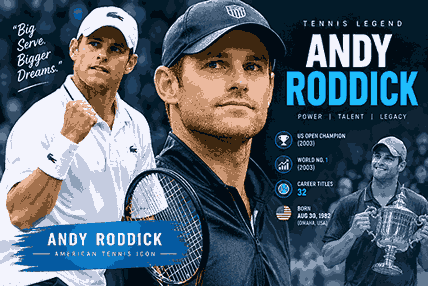
Andy Roddick stands as one of the most influential tennis players in American history. Born on August 30, 1982, in Omaha, Nebraska, he grew up in a sports-loving family that relocated to Boca Raton, Florida, when he was eleven to nurture his tennis talents.
Roddick turned professional in 2000 after claiming both the US Open and Australian Open junior singles titles. His rapid ascent through the rankings showcased raw power combined with competitive fire.
The tennis world quickly recognized his potential. By 2003, he had captured the US Open title and secured the World No. 1 ranking—a remarkable achievement at just twenty-one years old.
Key highlights:
- Born: August 30, 1982
- Turned Pro: 2000
- Career Titles: 32 ATP singles titles
- Grand Slam: 1 US Open title (2003)
- Highest Ranking: World No. 1 (2003)
2. Andy Roddick’s Early Life and Junior Career
Before becoming a tennis powerhouse, young Andy Roddick nearly walked away from the sport entirely. At seventeen, a frustrating losing streak in junior tournaments almost ended his dreams.
His coach, Tarik Benhabiles, convinced him to dedicate four more months to tennis. That decision changed everything.
Roddick finished 1999 as the No. 6 junior in the United States before claiming the top junior ranking globally in 2000. He won six world junior singles titles and seven doubles titles, establishing himself as a complete player.
His family’s support proved instrumental. The Roddicks moved from Texas to Florida specifically to provide better training opportunities. Andy’s older brother John had reached No. 6 in the world as a junior, setting a competitive example.
3. The Breakthrough Season That Changed Everything
The 2003 season transformed Andy Roddick from promising talent to Grand Slam champion. His summer run became the stuff of tennis legend.
At the Australian Open quarterfinals, Roddick battled Younes El Aynaoui in a five-hour epic. The fifth set stretched to 21-19—at the time, the longest deciding set in Grand Slam history.
He continued building momentum through the grass-court season, winning Queen’s Club and reaching the Wimbledon semifinals.
Then came the North American hard-court swing. Roddick captured consecutive Masters titles in Montreal and Cincinnati before arriving at the US Open as a genuine contender.
The 2003 US Open: Facing David Nalbandian in the semifinals, Roddick trailed two sets to love and faced match point. He saved it with a fearless serve and stormed back to win. In the final, he defeated Juan Carlos Ferrero in straight sets, sealing victory with three consecutive aces.
The victory made him the first American man to win a Grand Slam singles title since Andre Agassi in 1999.
4. A Record-Breaking Serve That Redefined Power
Andy Roddick’s serve became his signature weapon—a shot so devastating that opponents often could only watch in helpless admiration.
At the 2004 Davis Cup, he unleashed a 155 mph serve that set an ATP record. That same year, he recorded the fastest serve in Grand Slam history at the US Open: 152 mph.
These weren’t isolated moments. Roddick’s serve maintained remarkable consistency across surfaces and tournaments.
Roddick’s serve records:
- Fastest Davis Cup serve: 155 mph (2004)
- Fastest US Open serve: 152 mph (2004)
- Fastest Wimbledon serve: 143 mph
- Career aces: Over 9,000
The serve’s technical efficiency—a truncated, staccato motion—generated tremendous power while remaining repeatable under pressure. His ability to summon aces in critical moments made him one of tennis’s most clutch performers.
5. Battles with Roger Federer: A Defining Rivalry
Andy Roddick’s career intersected with Roger Federer at the worst possible time. Their rivalry defined an era and shaped how fans remember both champions.
Roddick reached five Grand Slam finals. Federer stood across the net in four of them. The Swiss maestro won all four meetings—at Wimbledon in 2004, 2005, and 2009, plus the 2006 US Open.
Despite the lopsided results, Roddick pushed Federer to extraordinary limits.
The 2009 Wimbledon final stands as their masterpiece. Roddick lost his serve only once—in the final game of a 16-14 fifth set. Federer later said, “In my mind, he is a Wimbledon champion”.
Grand Slam Finals Results:
| Year | Tournament | Result |
| 2003 | US Open | Won vs. Ferrero |
| 2004 | Wimbledon | Lost to Federer |
| 2005 | Wimbledon | Lost to Federer |
| 2006 | US Open | Lost to Federer |
| 2009 | Wimbledon | Lost to Federer |
This rivalry showcased Roddick’s resilience. He never stopped competing against the greatest player of his generation.
6. Career Statistics and Achievements
Andy Roddick’s numbers place him among tennis’s elite performers. His consistency across thirteen professional seasons demonstrated remarkable durability.
He finished in the ATP year-end top 10 for nine consecutive years from 2002 to 2010. This sustained excellence separated him from players who burned bright but faded quickly.
Career Highlights:
- Overall Win-Loss Record: 612-213 (74.18%)
- Grand Slam Record: 131-45 (74.4%)
- ATP Singles Titles: 32
- Masters 1000 Titles: 5
- Weeks at World No. 1: 13 weeks
- Davis Cup: Led USA to 2007 championship
Roddick’s five Masters 1000 titles included victories at Montreal, Cincinnati, Miami (twice), and a hard-court dominance that made him a perennial threat.
His Davis Cup performance deserves special recognition. Roddick compiled 33 singles victories for the United States—second only to John McEnroe in American history.
7. The Legacy: America’s Last Male Grand Slam Champion
Andy Roddick holds a distinction that grows more significant with each passing year. He remains the last North American male player to win a Grand Slam singles title.
That 2003 US Open victory closed a remarkable era of American tennis dominance. Pete Sampras and Andre Agassi had combined for twenty-two major titles. Roddick won the final one.
What followed was unexpected: a drought lasting over two decades. No American man has lifted a Grand Slam trophy since.
This reality wasn’t Roddick’s failure—it reflected a global shift. Federer, Nadal, Djokovic, and Murray elevated the sport to new heights. Competing against four all-time greats simultaneously proved nearly impossible.
Roddick’s legacy extends beyond statistics. His authentic personality, sharp wit, and competitive honesty made him one of tennis’s most compelling figures. He never pretended to be something he wasn’t.
8. Life After Tennis: Podcast Host and Media Personality
Andy Roddick didn’t disappear after retiring in 2012. He strategically built a media career on his own terms.
The COVID-19 pandemic opened unexpected doors. Tennis Channel invited him to provide remote commentary, and he discovered a genuine enjoyment for broadcasting that he hadn’t anticipated.
In January 2024, Roddick launched “Served with Andy Roddick,” a weekly tennis podcast. What began as a side project quickly became essential listening for tennis enthusiasts.
Served Podcast Milestones:
- 150,000+ YouTube subscribers
- 185,000+ social media followers
- 3.5 million+ audio downloads
- Marquee sponsors: Amazon Prime, Mercury Financial, ServiceNow
The podcast’s success caught even Roddick by surprise. “We thought there would be a lane for it for, like, super nerds,” he said. “But I don’t know that we thought it would grow like this”.
His analytical skills and insider perspective translated perfectly to broadcasting. In 2026, ESPN hired Roddick as an analyst for Wimbledon and US Open coverage.
9. Business Ventures and Philanthropic Impact
Andy Roddick applied the same competitive drive to business that defined his tennis career. His portfolio spans more than forty angel investments across diverse sectors.
Real estate provided his initial post-tennis foundation. He purchased commercial buildings with triple-net leases during the 2008 financial crisis, generating stable passive income.
More recently, Roddick co-founded ViewFi, a telehealth startup focused on musculoskeletal care. The idea emerged from a pandemic-era conversation with an orthopedic surgeon. ViewFi now employs approximately forty-five people.
The Andy Roddick Foundation represents his most meaningful work. Founded in 2001, it has raised nearly $40 million for afterschool programs serving low-income children.
Foundation Impact:
- Established: 2001
- Funds Raised: Nearly $40 million
- Focus: Youth education and economic opportunity
- Recognition: Arthur Ashe Humanitarian Award (2004)
Roddick’s charitable commitment earned him respect beyond tennis. He proved that athletic success could translate into meaningful social impact.
10. Personal Life and Family
Andy Roddick married model and actress Brooklyn Decker in April 2009. Their partnership has provided stability and perspective throughout his post-tennis evolution.
The couple has two children together. Roddick has spoken openly about how fatherhood reshaped his priorities and sense of purpose.
Despite his competitive nature, Roddick maintained a healthy perspective on life beyond tennis. He told Inside Tennis magazine about setting four primary goals: become No. 1, win the US Open, win Wimbledon, and win Davis Cup.
He achieved three of four. “Three out of four sounds pretty good,” Roddick reflected. “Those were lofty goals. One of those can make a lifetime”.
That gratitude—appreciating achievements rather than obsessing over what might have been—defines Roddick’s approach to life after tennis.
FAQs
What was Andy Roddick’s fastest serve?
Andy Roddick’s fastest serve was clocked at 155 mph during a Davis Cup match in 2004. He also holds the record for the fastest serve in US Open history at 152 mph.
How many Grand Slam titles did Andy Roddick win?
Andy Roddick won one Grand Slam singles title: the 2003 US Open. He reached four additional major finals—Wimbledon in 2004, 2005, and 2009, plus the 2006 US Open—losing all four to Roger Federer.
Did Andy Roddick ever become World No. 1?
Yes. Andy Roddick became World No. 1 on November 3, 2003, following his US Open victory. He held the top ranking for thirteen weeks and finished 2003 as the year-end No. 1.
Why is Andy Roddick considered the last American Grand Slam champion?
Roddick won the 2003 US Open, making him the most recent American man to capture a Grand Slam singles title. No American man has won a major championship since, a drought now exceeding two decades.
What is Andy Roddick doing now?
Andy Roddick hosts the popular “Served” podcast and works as an ESPN analyst for Wimbledon and US Open coverage. He also manages an extensive investment portfolio and runs the Andy Roddick Foundation.
How many ATP titles did Andy Roddick win?
Andy Roddick won 32 ATP singles titles, including five Masters 1000 championships. He maintained a top-10 ranking for nine consecutive years from 2002 to 2010.
Conclusion: Embracing Greatness on Your Own Terms
Andy Roddick’s story teaches something valuable: greatness isn’t only measured by trophies. It’s defined by how you compete, how you evolve, and how you give back.
He faced an impossible era—competing against Federer, Nadal, and Djokovic at their peaks. He won anyway. He reached No. 1 anyway. He built a legacy that extends far beyond any single match.
Today, Roddick models what successful reinvention looks like. He didn’t cling to past glory. He built new chapters—as a broadcaster, investor, philanthropist, and father.
His journey encourages us to pursue our own definitions of success. To compete fiercely. To adapt gracefully. To recognize when three out of four goals still represents an extraordinary life